When I came across the Fisher in my research, I went back to my blogs to find out if I had written about them. I said to myself, "Surely, I could not have forgotten the fishers." The truth was that I had actually forgotten these fine specimens of mustelidae. Oops. I really felt bad about this, because I did actually know about them. I passed over them several times because I had thought I had done a blog for them already. Once again: oops.
The fisher is a slightly chubby mustie living mostly in Canada. They have a body length of 47 inches and weigh about 6 pounds. Because of their natural habitat, they end up in a lot of snowy areas. I found it interesting that their feet are disproportionately larger than their legs which helps them walk on the snow. It's a lot like having snowshoes if you think about it.
I personally think fishers are adorable. They look like they would make a fine, cuddly plush animal. Their fur is pretty thick, which makes me want to hug them; although, I do not recommend doing that if you spot one. They might take a hug as some sort of local insult and try to bite your face off.
So, I'll give you one guess on what fishers like to eat. What could it possibly be? What do you think a fisher might want to chow down on? That's right! Chickens and mushrooms! Fishers do not eat fish, but hold on a moment! Did I say mushrooms? What is a mustie doing eating mushrooms?! Although it is very rare, fishers are actually omnivores. They are mostly known for hunting hares and porcupines, but they also go for various plants to add to the meals. The chickens they kill are often stolen from farms and are not really their natural prey.
Fishers prefer to be on their own and only group up for mating purposes. If you run into one, he'll probably watch you carefully. This creature does not really like trouble. If you approach him, he will probably run away, but if you corner a fisher, he will go on the offensive. They are not social animals at all. There has been a number of attacks on curious children who were probably trying to hug the cute things. Some animals just want to be left alone.
The fisher has been mentioned in several works of fiction. Unfortunately, I have not read most of them. In a book entitled, "Winter of the Fisher" by Cameron Langford, a recluse living in the forest frees a fisher from a trap and forms a not so perfect bond with him. The fisher is an animal shaman in the story "The Blood Jaguar" and a porcupine hunter in "Ereth's Birthday." My only personal fictional encounter with the fisher was in the comic book series "Mouse Guard." They are very dangerous solitary hunters who wear the carcasses of their victims as clothing, armor, and jewelry.
Between you and me, I tend to lean towards the way "Mouse Guard" explains things. The books really do a good job with their mustie and rodent lore. I like the idea of them being solitary savages. They hunt and kill for themselves only and greatly dislike any social interactions. I really like that! Still, it is a shame that I am not allowed to hug them.
Thank you for reading my blog! If you enjoyed it, you can comment below, or you can email me at tooie@tooiekangaroo.com. Snarl!
Wednesday, December 16, 2015
Tuesday, December 8, 2015
Mustelidae Spotlight: Marbled Polecat
Here is a very small member of the polecat family. The marbled polecat is only 13 inches from head to tail. I haven't really been seeing a lot of tiny polecats in the recent weeks, so that makes this little guy special.
The marbled polecat is also a visual spectacle. He has a fairly wide array of different designs on his body. There are lines on his face, stripes on his tail... polka-dots. Yeah, he must have lost a bet or something, but I have to give him credit for really pimping himself out for the world to see. I don't think you'd have much trouble identifying him in a group of other polecats.
Their behavior is aggressive--a very common polecat personality trait. You may wonder why such a tiny fellow should sport such an ire. Well, what does every polecat have in common? That's right! Anal scent glands! Polecats must be extra smart because they sure do have a lot of scents!
Marbled polecats are not so aggressive that they fire blindly. Don't worry, they'll keep the safety on for just enough time for you to run away. These musties put on a little display of warning to people or other animals that come their way. They raise up on their legs, arch their back, curl up their tail, and make all sorts of silly noises. These noises translate into, "I may be small, but I'm still dangerous!"
The marbled polecat likes to eat just about any kind of rodent or small bird he can get his paws on. Mustelidae is well-known for having a good set of teeth for tearing flesh, and they are wonderful hunters. Humans often employ the marbled polecat as "mousers" similar to cats. I do think, however, that a mustie with colors like the marbled polecat should be easier to see. But then again, they tend to favor desert areas, so it may work out for them after all. This species of polecat can be found in the drier areas and grasslands of southeastern Europe to western China.
Fiction-wise, let me just be blunt. This polecat is a pimp. I mean... if you just look at him in the pictures below. the guy really knows how to make an appearance. I imagine these guys do have a mean streak, but otherwise, they make up for any flaws by simply flaunting it! Hey, when you are that short, you might as well make the best of it.
Thank you for reading my blog! If you enjoyed it, you can comment below, or you can email me at tooie@tooiekangaroo.com. See ya next time!
Monday, November 30, 2015
Mustelidae Spotlight: Black-Footed Ferret
T.K. Wade was not available today, but he asked me (the awesome black-footed ferret) to write this up. Besides, I know how awesome I am. I should be able to do an awesome job without his help!
My species goes by a few different names. Other than the entirely classy title of black-footed ferret, we are also sometimes called American polecats, or the very apt title of prairie dog hunter. But no matter what you call us, we are awesome, and also, we are awesome. Did I mention that we are awesome?!
So, T.K. Wade usually gives measurements about now. I took a measuring tape and wrapped myself in it. It sure was fun, but I didn't learn anything. Us ferrets don't have much use for numbers anyways. Let's just say that I have the perfect length because I am awesome!
As the latter name suggests, I really dig those prairie dogs for my vittles. The only problem is that sometimes when I chase them, they run away. This is annoying. How am I supposed to have a yummy prairie dog meal if it runs away from me? That is not awesome. Many of us black-footed ferrets--as well as other musties--were going hungry cause of this. We got all our ferret scientists together and formed a think tank in an effort to solve the perplexing issue.
We finally came up with a solution. If as first you don't succeed, just go crazy! That's right! When we have trouble catching our food, we perform something known as the "Weasel War Dance!" It is a fairly complicated procedure, but in layman's terms, we jump, roll, skip, run into things, fall over, shake our butts, and do about twenty other top secret maneuvers which all coalesce into attracting the attention of our prey and making them say, "What the heck am I looking at?" And that, my friends, is when we strike.
It really works. Remember, all those many musties came together to create the "Weasel War Dance," and it is a very top secret affair. I have seen some human's try to perform a similar dance--one they apparently call "Break Dancing," but it has yet to get them anything more than money. Not that money is a bad thing. I love money myself. It's all very shiny, but it won't feed you as well as a good, fat prairie dog will.
There is no fiction about my species, but there should be. I think we are very awesome animals. We could be spell casters who cast spells by dancing. It could be a whole tribe of dancers, if you think about it. We could have an entire community who all sleep together at night while wrapped in measuring tape. Sounds like paradise to me!
Thank you for reading this awesome blog written by an awesome ferret. If you enjoyed this awesome blog, you can comment about how awesome it was in the awesome section below, or you can send an awesome email to T.K. Wade at tooie@tooiekangaroo.com. Awesome!
Sunday, November 29, 2015
I Have Read Every Baum Book!
I just want to say that as of about 10 minutes ago, I have read everything Lyman Frank Baum has ever written that is still available to this day. It took me nearly 2 and a half years.
That is:
65 books.
29 short stories.
6 stage plays.
1 completely collected newspaper column. (1890-1891)
It is done. There is no more to do. I regret nothing. I feel like I am a far better person than before I began. Thank you, Mister Baum, for being such an inspiration in my life.
Tuesday, November 24, 2015
Mustelidae Spotlight: Striped Polecat
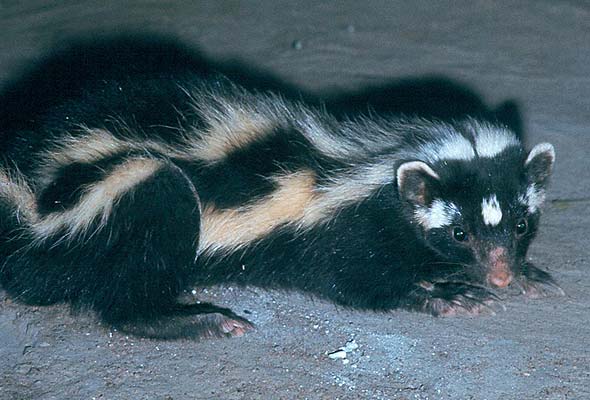
The striped polecat is probably one of the main reasons why we tend to use the word for skunks fairly often. These musties look like skunks--only with a particular variation in stripe pattern. The pictures should make this clear. I did not find a bounty of information on these guys, but I'll tell you what I know.
The striped polecat can be found in many areas of central and southern Africa. They like the more dry and arid climates such as savannahs and open countries. As far as size, they are 28 inches in length with a nearly 6 inch tail. As with all polecats, they have a defensive anal scent gland which we will talk more about in a bit.
I was shocked at how many names this musty has. Depending on who you ask, the striped polecat can be known as an African polecat, a zoril, zorilla, the Cape polecat, or the African skunk. The name zorilla apparently comes from the word zorro which means "fox." Bur really! Zorro?! Why isn't he in California?!
The striped polecat doesn't make friends easily. The only time two striped polecats get together is likely for mating purposes. They really just like to be left alone. They roam about almost entirely at night hunting small animals like rodents, snakes, and birds. In the daytime, they sleep in burrows NOT made by them. This is similar to the steppe polecat. This guy is known for invading the burrow uninvited, and if anyone gets in his way, they get acquainted with his 34 sharp teeth.
Now, skunks are actually known for being fairly indifferent with other animals. If you get in their way, they just spray you and walk off. The striped polecat, however, is just mean. If he sees someone who he doesn't expect, its a prelude to war. This is what will happen: First, the striped polecat will growl in a nasty way. He'll turn around dramatically with his tail in the air. (Here comes the bad part.) He'll spray you with a nasty concoction that will not only smell terrible, it will also blind you. This is a new kind of bad. Imagine being in the middle of Africa blind and smelly. That will probably be the end of you.
I really was impressed with how aggressive these guys are. Skunks spray out of defense; the striped polecat sprays anything that moves. Sometimes, nature just works out that way. They say that a good offense is the best defense. Well, that's true. If I ever saw one of these guys, I'd just run away without saying, "goodbye." It is for this reason that I see these guys more suitable as villains in fiction. I just see one of these musties sitting in a "mastermind's swivel chair" railing to the world that nobody understands him, so everyone must pay! He's going to make the world stink! All his henchmen have to wear hazmat suits because he doesn't get along with anybody. See how this would be fun? I sure do!
The striped polecat is a cute, little meanie and yet ANOTHER reason not to go to Africa. They may look like skunks, but believe me: they are a lot worse!
Thank you for reading this blog! If you enjoyed it, you can comment below, or you can email me at tooie@tooiekangaroo.com. I'm blind!
Tuesday, November 17, 2015
Mustelidae Spotlight: Steppe Polecat
You know, there have been many times where I have heard skunks referred to as polecats. This likely comes from the fact that many breeds of polecats have similar anal scent glands and the ability to spray as a manner of defense. However, not all polecats look like skunks. The steppe polecat is one example.
The steppe polecat can be found in Central and Eastern Europe and Central Asia. They have a body length of about 22 inches and sport a coat of light and dark brown. I think they look really cool, to be honest. Their eyes, in particular, are very dark and seem empty in a scary way. Often, there is a light outline around these eyes creating a contrast. It is very peculiar to look at indeed.
So! What makes a steppe polecat so fascinating? These musties tend to live underground, but they almost never dig their own burrows. It is FAR more common for them to take over the home of another animal fellow. It's usually the unfortunate fate of some random ground squirrel who is promptly killed before the steppe polecat moves in. I know what you are thinking: He's lazy. However, this particular mustie does keep quite busy.
The reason he likely ends up stealing burrows is because he is just so busy going about killing rodents and other small mammals. This aspect of the steppe polecat is a major duty for him. They are constantly running about killing many, many squirrels, hamsters, marmots, moles, and many others. I know it sounds cruel, but many of these little animals can cause trouble for humans living nearby. People generally like the steppe polecat for dispensing of these little trouble makers with such precision. He is actually a force for good. Bet you didn't expect that!
In fiction, I really do see the steppe polecat as the professional assassin working for the side of good. He doesn't necessarily have to be going after little guys like rodents. In fiction, all you really need to concern yourself with is the characters persona and inherent skills. Who you put him against very well could be anything under the sun. As an example, he could be sent out to take care of an army of mischievous ferrets. I'd only pit him against a large group of baddies. Really, this mustie could very well be the Audie Murphy of the mustelidae family. I like the idea of a lone fighter who takes on an army as a force of good.
The nature of the steppe polecat is to spend his days cleaning the world of little nuisances. If he happens to rid a burrow of one of these nuisances, he invites himself in the for the night. I don't blame him for doing so. After all, when you consider all the killing he has planned for the next day, he's gonna need all the napping he can get.
Thanks for reading this blog! If you enjoyed it, you can comment below, or you can email me at tooie@tooiekangaroo.com. Growl!
Wednesday, November 11, 2015
Mustelidae Spotlight: Honey Badger
Well, it seems we will be remaining in Africa this week. I hope to leave soon, because it is about to get rather dangerous for me. Oh dear! It's a honey badger, and he's out to eat anything that moves! Let's begin with his measurements.
The honey badger is actually very large. From head to tail, he measures a whopping 30 inches with a tail that can be as long as 11.8 inches. In addition to this already large number, he has an impressive shoulder height of 11 inches. Chances are, you will see this musty coming. The honey badger is actually the largest terrestrial mustie in Africa. I'd pin a ribbon on him, but it would never stick. I'll tell you why shortly.
Honey badgers have a reputation for being large and dangerous. They have an amazing offense and defense--rather than just one or the other. Offense-wise, they have very sharp claws, but I was particularly fascinated with their teeth. If there is one thing that nearly every mustie has, it is a fine set of teeth. But really, the honey badger has got to have the most disorderly dental problems of all time. Their teeth regularly grow in weird uneven patterns, and this really does seem to be a defect of the species. Still, you would not want to be bit by one. If only they could afford an orthodontist!
Defense-wise, it all comes down to having a coat that is so thick and coarse that not even dogs can tear into it. This coat nearly makes the creature invincible, and it comes especially handy when trying to get to its favorite food: honey. The bees can sting and sting all they want, but it won't bother the honey badger one bit. A secondary defense comes in the form of a bizarre anal pouch which produces one of the most terrible smells that has ever existed in nature. It is positively suffocating. Apparently, this special brand of stink also assists with the bees. Half of them pass out before they even get a chance to sting him. Yep, that rear of his is a real scent-sation! Okay, moving on...
Although honey badgers prefer honey, they actually don't care what they eat. Just put it in front of them, and they'll try it. Just think of him as nature's vacuum cleaner. If you won't, I certainly will. It is amazing how many musties have specialized diets. The honey badger simply does not care what it eats, and that makes it very versatile in the wilds of Africa.
Honey Badgers are also very clever. Like some species of otter, these musties are known to use tools for various tasks. They can use sticks, mud, or just about anything to make something happen. It is almost impossible to trap a honey badger for this reason. They tend to figure out how to use its surroundings to find a way out, and then it will try to bite of your face as punishment!
The honey badger in fiction is somewhat intermixed with its personality. In most fiction, the honey badger is portrayed as an unfeeling and dangerous beast that kills for no other reason than it's Tuesday. There are a couple reasons for this. The mustie is actually very aggressive but also seems to never really have the optics of aggression. He looked rather bored when he chased off a pack of lions and made off with their food. (Yes, that really happened.) So, they have a reputation for acting this way.
The second reason actually came in the form of a viral video called "Crazy Nastyass Honey Badgers" from 2011. This was actually a comical dubbing of a National Geographic video where a narrator going by the name Randall showed us images of a honey badger invading beehives, being bitten by cobras, and doing all other manner of crazy things while living through all of it. The tagline of the whole thing was that "Honey Badgers Don't Care" which was also the title of a book he released that same year.
After this video captured both the hearts and disgust of the public, everyone had to have their own honey badger moment in their movie or video game. There was even a comic book series called "Honey Badger" about how the indifferent mustie takes on the world without having any feelings for anything at all ever. I actually own one of the issues. Also, Disney's new TV show "The Lion Guard" has a honey badger character named Bunga. Face it, this musty is too cool to disappear.
This blog has already gone a bit too long, so let me end it with my own take. It is clear that if anyone likes the honey badger, he likes him for being an uncaring, invincible jerk that just does whatever he wants without suffering the consequences. He has all the power in the world, but doesn't care one way or another. In the end, he is just a highly skilled nobody that is fun to watch, and that is why we keep talking about him. I suppose we have Randall to thank for popularizing this mustie, but that's okay. Sometimes, it takes a little imagination mixed with humor to make the obscure things in the world interesting. Thank you, Randall!
You are awesome for reading my blog! If you want, you can leave a comment below, or you can email me at tooie@tooiekangaroo.com. Whatever!
Subscribe to:
Posts (Atom)